Florida, private property
Dead Animal in an Attic or Soffit
If something has died in the roof space, the useful question is whether it is lying on the attic floor, in the insulation, or inside a soffit that can be opened from outside. Those are all reachable. Behind a finished ceiling is not.
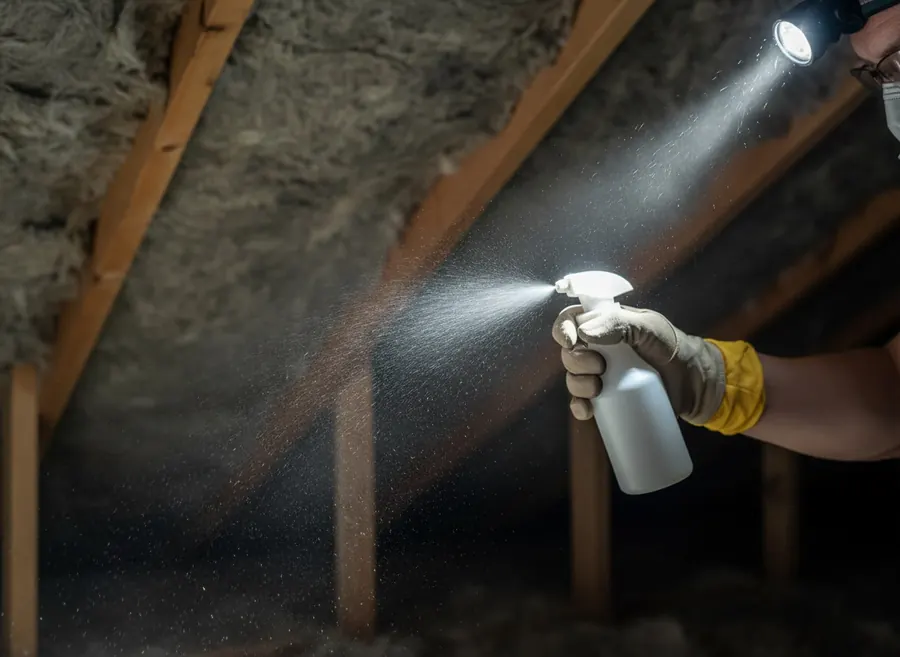
Before you pay anyone. Nothing public covers this anywhere in Florida. Not one city or county service in our source list mentions an attic, a soffit or a roof void. If there is a smell in your roof space, there is no free number to try first.
What this covers
- An animal on the attic deck or lying in insulation
- A soffit or eave void that can be opened from outside and closed again
- A gable vent, ridge vent or roof return where something has got in and died
- Attic ductwork and around air handlers, where the smell travels through the system
- Insulation that has been contaminated and needs lifting out with the animal
Where the limit is
A carcass inside a finished wall cavity reached only by cutting drywall or plaster. That is covered honestly on the odor page rather than sold here.
Florida attics are hot, and that matters practically rather than dramatically. Heat and humidity generally accelerate decomposition, which is why a roof-space animal usually announces itself faster here than in a cooler climate. It also means working conditions are genuinely difficult, and an operator may want to go early in the day.
How a call goes
- You describe where the smell is strongest and whether it moves with the air conditioning, which often points at ductwork rather than the attic floor.
- We check whether an independent operator is available for your address. Nobody's coverage is confirmed in Florida yet.
- The operator works the accessible parts of the space: the deck, the insulation, the soffit and eave voids, and around the ducts.
- The animal and any contaminated insulation come out together, and the area is cleaned and treated.
- If the source turns out to be inside a wall, you are told what that actually means before anyone cuts anything, and the decision is yours.
Questions about this situation
Why is the smell worse when the air conditioning is running?
Because air handlers and ducts are commonly in the attic in Florida, and a carcass near a return or a leaking duct joint gets its odor distributed through the house every time the system cycles. That is a useful clue and worth mentioning on the call, because it narrows where to look.
Does the insulation have to come out?
Where an animal has been lying directly in it, usually the affected area does, because the material holds the fluids and the smell. That is a local lift-out rather than stripping the attic.
Can you get into a soffit?
Often, yes, from outside. Soffit panels are designed to be removable, which makes a soffit one of the better outcomes when something has died in an awkward spot.
Is it safe for me to go up and look?
That is your call, but a Florida attic in summer is genuinely hazardous on heat alone, before the carcass is considered. The state wildlife agency's published guidance is to avoid touching a carcass at all, to use gloves or bags worn on the hands, and to work upwind of it where you can.
Not sure this is the right page? Who removes a dead animal in Florida works through the public and private split, and the county pages give the published position where you live.